Markus Anecdotes-Cozy Conversations
- vusharon
- 6 hours ago
- 16 min read
Written with Photos by Markus

It was one of those rare Dutch afternoons when the weather forecast finally contained that magical little yellow circle instead of endless grey clouds. The electronic display outside Tilburg station proudly announced 18°C. Back in Singapore, nobody would have given that number a second glance. In fact, if an office air-conditioning system had been set to 18°C, someone would almost certainly be searching for a jacket or asking the facilities department whether the thermostat had gone haywire.
Yet as I walked towards the city centre after finishing work, I honestly thought I had stumbled into some sort of celebration.
Every café terrace was full.
Not just busy. Full.
Every chair had someone sitting in it. Every table held at least one cup of coffee, one glass of beer or a plate with something delicious on it. Cyclists were carefully squeezing between parked bicycles to find a place to lock theirs. Waiters hurried from table to table with trays balanced effortlessly on one hand. Elderly couples sat quietly reading newspapers. Young families laughed while toddlers attempted to feed crumbs to impatient sparrows. University students appeared to have collectively decided that lectures could surely wait until tomorrow.
Even the dogs looked unusually content, stretched out beneath tables like seasoned café regulars.
I slowed down and looked around.
"Did PSV win something?"
No.
"Is it King's Day already?"
No.
"Free beer?"
Definitely not.
The answer was much simpler.
The sun was shining.
After living in the Netherlands for several years, I have learned that there are few things capable of transforming an entire nation as quickly as a sunny afternoon. Elections don't create this level of excitement. Major football matches sometimes do, but not always. Yet give the Dutch a blue sky after several days of rain, and suddenly every terrace in the country looks as though someone has announced an emergency national gathering.
Back when I first arrived, I simply couldn't understand it.
Eighteen degrees?
Really?
In Singapore, eighteen degrees would probably make the evening news.
People would dig sweaters out from the back of wardrobes. Social media would fill with photographs of thermometers. Someone would proudly announce they had finally been able to sleep without turning on the air-conditioning.
Meanwhile, here in the Netherlands, eighteen degrees seems to trigger a completely different response.
Out come the sunglasses.
The jackets mysteriously disappear.
Someone somewhere decides shorts are appropriate.
And within what feels like fifteen minutes, every outdoor café has become fully occupied.
The first time I witnessed this phenomenon, I genuinely believed there must be a festival taking place. Surely there had to be a reason thousands of otherwise sensible people had suddenly chosen to sit outside.
Then I looked at the weather forecast.
A small yellow sun.
No rain expected until tomorrow.
Mystery solved.
Coming from Singapore, this required quite an adjustment. Growing up, sunshine wasn't something you chased. It was something you escaped.
When friends wanted to meet, the first question wasn't whether the café had outdoor seating. It was whether the air-conditioning was strong enough.
Shopping malls weren't simply places to buy things. They were wonderful climate-controlled sanctuaries where you could comfortably spend an entire afternoon without worrying about melting into the pavement.
If someone suggested sitting outside at two o'clock in the afternoon, most Singaporeans would politely assume that person wasn't thinking clearly.
Shade was valuable.
Air-conditioning was precious.
Walking under direct sunlight for longer than necessary often felt like an endurance sport.
Moving to the Netherlands completely reversed that logic.
Here, sunshine behaves almost like an honoured guest who never confirms whether it
will attend the party.
It might appear.
It might not.
When it does appear, nobody wastes the opportunity.
I soon discovered that Dutch weather forecasts receive an astonishing amount of attention. At first, I assumed people were simply making conversation.
"Looks sunny on Saturday."
"We should sit outside."
"The terrace will be nice."
I heard these conversations everywhere.
At work.
On trains.
In supermarkets.
In cafés.
Neighbours discussed sunshine with the seriousness of economists analysing financial markets.
Eventually I realised these weren't casual remarks.
These were plans.
In Singapore, if Saturday turns out sunny instead of rainy, life continues exactly as planned.
In the Netherlands, sunshine can rewrite an entire weekend schedule.
People postpone housework.
Gardening suddenly becomes urgent.
Boats appear on canals.
Barbecues materialise out of nowhere.
Cyclists emerge in astonishing numbers.
And terraces...
Terraces become the centre of the universe.
I used to think cafés made most of their money selling coffee.
Now I'm convinced they also sell something much more important.
Permission to slow down.
One Saturday afternoon, I decided to experience this famous terrace culture properly.
The forecast predicted sunshine all day.
I arrived in Breda shortly after lunch, feeling rather pleased with my excellent planning.
Unfortunately, approximately everyone else in the province had made exactly the same plan.
The Grote Markt was overflowing.
Every terrace looked alive.
Conversations blended together into a cheerful background hum. Glasses clinked. Coffee machines hissed. Children chased pigeons between tables while their parents apologised to amused waiters who clearly had seen this happen a thousand times before.
I confidently approached one café.
Full.
No problem.
There was another one across the square.
Also full.
Surely the next one...
Full again.
By now I had become strangely invested in this mission. Finding an empty chair had turned into a personal challenge.
The funny thing was that nobody appeared to be in any hurry to leave.
In many countries, cafés are places where customers eat or drink, settle the bill and continue with their day.
Dutch terraces seem to operate under different rules.
Order a coffee.
Talk.
Watch people walk past.
Order another drink.
Continue talking.
Notice the sunshine has shifted.
Move your chair twenty centimetres.
Carry on.
Time slows down.
Nobody seems guilty about it.
Eventually, after wandering around the square like someone searching for hidden treasure, I spotted a tiny table becoming available.
I increased my walking speed just enough to appear determined without looking desperate.
Success.
For a glorious moment.
Before I reached it, a cheerful elderly couple arrived from another direction with remarkable efficiency. They smiled warmly, thanked the waiter and sat down.
I couldn't even be disappointed.
They had clearly been playing this game much longer than I had.
I laughed to myself and continued searching.
Eventually I found a small terrace tucked away on a quieter street. The waiter apologised that only one tiny table remained.
"It'll do perfectly," I replied.
He smiled.
"The sun will reach your table in another ten minutes."
Only in the Netherlands, I thought, would sunlight come with an estimated arrival time.
I ordered a cappuccino and simply watched the afternoon unfold.
There is something strangely hypnotic about sitting on a Dutch terrace.
Nothing dramatic happens.
Yet everything happens.
Cyclists glide past almost silently.
Friends greet one another with three kisses or a warm hug.
Someone parks a bicycle that probably costs more than a small second-hand car.
A golden retriever patiently waits beneath its owner's chair, occasionally rewarded with tiny pieces of bitterballen.
A young couple spend twenty minutes deciding whether to order apple pie.
An elderly gentleman carefully folds his newspaper before taking his first sip of coffee, as though the ritual itself deserves respect.
Nobody appears rushed.
Nobody constantly checks their phone.
Nobody seems anxious about what comes next.
Instead, people simply exist in the moment.
Coming from fast-paced Singapore, where efficiency often feels like a national hobby, this fascinated me.
Back home, I had become accustomed to measuring afternoons by what had been accomplished.
Errands completed.
Shopping finished.
Appointments kept.
Emails answered.
Here, an afternoon could be considered wonderfully successful simply because the sun had appeared and good company had lasted longer than expected.
At first, I thought this attitude was unusual.
Then I slowly realised it might actually be rather wise.

One of the first Dutch words I learned that simply refuses to be translated properly is gezellig. Every dictionary tries its best. Some suggest "cosy." Others say "pleasant," "comfortable," or "convivial." None of them quite capture what the Dutch mean when they use the word.
A rainy evening with candles, hot chocolate and family can be gezellig.
A birthday party can be gezellig.
A Christmas market can be gezellig.
Oddly enough, a crowded café terrace with fifty people talking at once can also be gezellig.
At first, this completely confused me.
How could something noisy be cosy?
Then one afternoon, sitting outside with a coffee while watching life drift slowly past, I finally understood. Gezellig isn't really about furniture, candles or decorations. It's about atmosphere. It's that comfortable feeling of being exactly where you want to be, with people you enjoy, without feeling any pressure to rush off and do something more productive.
The Dutch seem remarkably good at creating that feeling.
It doesn't matter whether they're drinking coffee at ten in the morning or sharing a beer at six in the evening. The conversation is what matters. Time somehow stretches itself.
In Singapore, we often joke that lunch is a race against the clock. Office workers queue efficiently, eat efficiently and return to work efficiently. Even weekend gatherings sometimes have an invisible timetable because another appointment is waiting just around the corner.
Here, the timetable occasionally seems to disappear.
I've watched two elderly gentlemen spend nearly three hours over what appeared to be two cups of coffee.
They weren't glued to their phones.
They weren't watching television.
They weren't working on laptops.
They simply talked.
Every now and then they would stop, look around the square, watch a cyclist wobble past with an impossible stack of shopping bags, smile quietly and continue their conversation as though they had all the time in the world.
Perhaps they did.
One thing that continues to amuse me is the Dutch relationship with sunshine itself.
They don't merely enjoy it.
They actively pursue it.
I once watched a couple perform what could only be described as a carefully coordinated terrace migration.
When they first sat down, their table was bathed in warm sunshine. Half an hour later, as the sun moved behind the neighbouring building, the shade slowly crept across their table.
Without exchanging more than a glance, they picked up their drinks, lifted their chairs and moved exactly two metres to another table that was still illuminated.
Problem solved.
Ten minutes later, another group copied them.
Soon, the entire terrace had quietly rearranged itself to follow the sun.
Nobody thought this was strange.
In fact, the waiter calmly helped move a heavy table to accommodate everyone.
Back in Singapore, we usually move our chairs to escape the sun.
Here, people move towards it.
The first time I experienced this, I instinctively chose a table under a large umbrella.
Old habits die hard.
The waiter smiled politely.
"You know," he said, "if you move over there you'll get some sunshine."
I laughed.
"No thanks. I'm happy here."
He looked genuinely puzzled.
Happy... in the shade?
Clearly, I still had much to learn.
The Dutch also possess an extraordinary talent for convincing themselves that it is warmer than it actually is.
The thermometer says 19°C.
The weather app warns of a cool breeze.
I leave the house wearing a light jacket.
Meanwhile, I pass someone jogging in shorts.
Another person is wearing sandals.
Someone else appears to have concluded that a sleeveless shirt is entirely appropriate.
Children run through fountains as though it's midsummer.
I quietly zip my jacket a little higher and wonder if perhaps I'm simply becoming old.
Eventually, I realised temperature isn't the deciding factor.
Sunshine is.
If the sky is blue, the number on the thermometer becomes almost irrelevant.
I've also noticed that Dutch terraces operate according to a wonderfully relaxed code of etiquette.
Nobody hurries you.
Nobody subtly places the bill on the table in the hope you'll leave.
Nobody seems worried if you've been sitting there for an hour after finishing your drink.
Instead, the staff somehow manage to strike a perfect balance between attentiveness and giving you space.
Coming from a logistics background, I sometimes find myself automatically observing systems.
Warehouses.
Train stations.
Airports.
Restaurants.
Every operation has a rhythm.
Dutch terraces have one too.
It looks effortless, but it's incredibly well organised.
Waiters weave gracefully through impossibly narrow gaps carrying trays loaded with six or seven drinks.
They remember which table ordered the cappuccino with oat milk, which family requested extra mayonnaise for their fries, and which couple asked for another slice of apple pie.
Despite the crowds, very few people appear impatient.
Everyone seems to understand that beautiful weather is good news for everyone, including the staff.
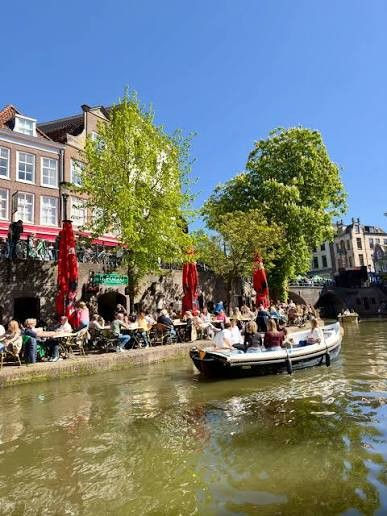
One Saturday in Utrecht, I found a seat beside one of the canals.
If you've never experienced a Dutch canal on a sunny afternoon, imagine the entire city collectively deciding to smile.
Boats drift slowly past, each carrying friends enjoying wine, cheese, sandwiches or simply the pleasure of being outdoors.
People sitting on the canal walls dangle their feet above the water.
Children wave enthusiastically at passing boats.
Complete strangers wave back.
Someone begins playing a guitar.
Further along the canal, a group celebrate a birthday.
Nobody seems particularly concerned about impressing anyone.
They're simply enjoying themselves.
I ordered a portion of bitterballen, one of those wonderfully Dutch snacks that should probably come with a warning label.
The outside is deliciously crispy.
The inside is approximately the temperature of molten lava.
Every newcomer learns the same lesson.
You become impatient.
You bite into one immediately.
You burn the roof of your mouth.
You promise yourself never to make that mistake again.
A month later, you do exactly the same thing.
Some traditions are unavoidable.
As I sat there cautiously waiting for my bitterbal to cool down, I noticed another uniquely Dutch detail.
Dogs.
Dogs are everywhere.
Large dogs.
Small dogs.
Old dogs.
Puppies.
They lie quietly beneath café tables with remarkable patience, occasionally lifting an eyebrow whenever food appears.
Nobody seems bothered by their presence.
In fact, many waiters automatically bring a bowl of water without being asked.
Coming from a household with dogs myself, I always enjoy seeing how naturally they are included in everyday Dutch life.
They're not treated as an inconvenience.
They're simply part of the afternoon.
Then there are the bicycles.
If you sit on a terrace long enough, you begin to appreciate that bicycles tell stories.
Parents transporting three children and two school bags.
Students balancing enormous bouquets of flowers.
An elderly lady cycling one-handed while chatting happily on the phone using a headset.
A businessman in an expensive suit riding faster than most cars could drive through the city centre.
Teenagers laughing as they attempt to cycle side by side.
Every few minutes another miniature story glides past.
Sometimes nothing more dramatic happens than someone dropping a glove or struggling to unlock a bicycle with the wrong key.
Yet somehow it's endlessly entertaining.
Perhaps that's the hidden beauty of Dutch terrace culture.
You don't go there because something extraordinary is going to happen.
You go because ordinary life is surprisingly interesting when you finally slow down enough to notice it.
I think that's the lesson I wasn't expecting when I moved here.
Singapore taught me to value efficiency, reliability and making the most of every minute.
The Netherlands has quietly introduced me to another idea.
Not every minute needs to be productive.
Sometimes a perfectly good afternoon consists of a coffee that lasts an hour, a conversation without checking the time, and watching sunlight dance across old brick buildings while cyclists and boats provide an ever-changing backdrop.
I still wouldn't call 18°C "warm."
But I no longer think it's too cold to sit outside.
That's probably the first sign that the Netherlands has slowly been changing me.
The real surprise wasn't discovering how much the Dutch love their terraces.
The real surprise was discovering, one sunny afternoon, that I had quietly become one of them.
It happened so gradually that I almost missed it.
When I first moved to the Netherlands, I rarely looked at the weather forecast unless I wanted to know whether I needed an umbrella. Rain was simply part of life. If it rained, I wore a waterproof jacket. If it didn't, even better. End of story.
Then something changed.
One Thursday evening, while eating dinner, I casually opened my weather app.
Friday looked wet.
Saturday looked cloudy.
But Sunday...
Sunday had a bright yellow sun next to it.
Without thinking, I smiled.
"Maybe we should go somewhere with a nice terrace."
I actually said those words aloud.
Halfway through the sentence, I stopped and laughed.
A few years earlier, I would probably have suggested visiting an air-conditioned shopping centre. Now I was planning my weekend around the possibility of sitting outside.
Somewhere along the way, the Dutch had successfully recruited another member.
It's amazing how countries quietly influence the people who live in them.
Nobody sits you down and says, "From today onwards, you'll start appreciating sunshine differently."
It just happens.
One spring morning, you notice you're leaving the house without your heavy winter coat.
A few weeks later, you're carrying sunglasses in your bag.
Soon after that, you're debating whether it's warm enough for lunch outside.
Then one day, you realise you're doing exactly what your Dutch colleagues have been doing all along—tilting your face towards the sun whenever it appears, almost like a sunflower.
At work, these changes become particularly noticeable.
During the winter months, conversations often begin with comments about the weather.

"Rain again."
"Quite windy today."
"I don't think we'll see the sun this week."
Nobody sounds especially surprised.
Then, almost overnight, everything changes.
The weather forecast predicts two sunny days.
Monday morning suddenly feels more cheerful.
People walk into the warehouse smiling.
Someone says, "It's supposed to be twenty-one degrees this weekend."
Another colleague replies, "Perfect barbecue weather."
By lunchtime, people are already discussing where they'll sit after work.
One person recommends a terrace in Tilburg.
Another prefers Breda.
Someone else insists that Den Bosch has the nicest atmosphere.
The conversation sounds remarkably similar to football fans debating which stadium serves the best food.
The destination matters.
But being outside matters even more.
One Friday afternoon, a Dutch colleague asked if I wanted to join everyone for a drink after work.
I agreed.
As we walked towards the café, I noticed something interesting.
Nobody even glanced at the indoor seating.
There were plenty of empty tables inside.
Soft lighting.
Comfortable chairs.
No breeze.
Yet everyone headed directly outside.
The only available table was squeezed into a corner beside the pavement.
Cars occasionally passed.
Cyclists rang their bells.
A cool breeze wandered through every now and then.
Nobody cared.
"We've been inside all week," someone said simply.
That one sentence explained everything.
The terrace wasn't just about drinking coffee or beer.
It was about escaping four walls.
About celebrating daylight.
About reminding yourself that winter eventually ends.
Perhaps that's why Dutch terraces always feel so optimistic.
In countries where sunshine is guaranteed, pleasant weather can become almost invisible. It's simply part of the background.
In the Netherlands, every sunny afternoon still feels slightly special.
Maybe because everyone knows it won't last forever.
If rain arrives tomorrow, they'll simply wait for the next opportunity.
And when it does arrive...
They'll be back.
One thing I've grown to admire is that the Dutch don't seem obsessed with perfection.
The terrace doesn't need to overlook a famous monument.
The coffee doesn't have to come from the world's rarest beans.
The chairs don't all have to match.
Sometimes the best terrace is simply the one where your friends are sitting.
I've had wonderful afternoons overlooking historic canals.
I've also had equally enjoyable conversations sitting beside an ordinary town square where the most exciting event was watching an elderly gentleman carefully park his bicycle.
The company created the atmosphere.
The sunshine simply added the finishing touch.
Over time, I've also become fascinated by the changing rhythm of Dutch towns.
Visit the same square on a rainy Tuesday morning.
People hurry past.
Umbrellas open.
Cyclists lower their heads against the wind.
The terraces sit empty, their chairs stacked neatly together.
Return forty-eight hours later when the sun appears.
It's almost unrecognisable.
The same square suddenly feels alive.
Children chase bubbles.
Street musicians appear.
Ice cream queues form.
Friends wave enthusiastically across the square after spotting each other from fifty metres away.
The buildings haven't changed.
The cafés haven't changed.
Only the weather has.
Yet the entire atmosphere feels transformed.
Sometimes I wonder whether sunshine changes the country.
Or whether it simply reveals the version that was patiently waiting underneath all along.
Of course, not every terrace experience goes perfectly.
I've learned that Dutch weather has an excellent sense of humour.
More than once I've proudly chosen an outdoor table, ordered my coffee, leaned back in satisfaction...
...and watched a dark cloud drift slowly overhead.
Five minutes later, the waiter arrives carrying everyone's drinks while tiny raindrops begin to fall.
Nobody panics.
Nobody runs.
People simply look upwards.
"It's only a shower."
Sometimes they're right.
The rain lasts three minutes.
The sunshine returns.
Everyone carries on exactly where they left off.
Other times...
Let's just say umbrellas suddenly become extremely fashionable.
One afternoon in Utrecht, I experienced perhaps the most Dutch moment of all.
The terrace had been packed for over an hour when a brief rain shower passed through.
People shuffled under large umbrellas.
The waiter continued serving drinks as though nothing unusual was happening.
Within ten minutes, the rain stopped.
Then something remarkable happened.
Instead of leaving, everyone simply moved their chairs back into the sunshine and resumed their conversations.
It was almost choreographed.
As though they'd all silently agreed that a little rain wasn't going to waste such a beautiful afternoon.
I couldn't help smiling.
A few years ago, I probably would have headed indoors at the first sign of rain.
Now I waited with everyone else.
Apparently, I had become more Dutch than I realised.
These days, when family or friends from Singapore visit, I sometimes catch myself saying things I never imagined I'd say.
"Let's sit outside."
"The weather's lovely."
"We should enjoy the sunshine while it lasts."
Occasionally they look at me with mild concern.
"It's only nineteen degrees."
I nod.
"I know."
"But the sun is out."
Those words still make me laugh.
If someone had told me years ago that nineteen degrees would one day feel like an invitation rather than a warning, I would never have believed them.
Living abroad changes you in unexpected ways.
Sometimes it's the language you begin using without noticing.
Sometimes it's the food you grow to love.
Sometimes it's discovering that cycling in the rain is simply part of normal life.
And sometimes it's finding genuine happiness in something as wonderfully ordinary as sitting outside with a coffee while the afternoon drifts gently by.
Whenever I return to Singapore, I quickly readjust.
The tropical warmth feels familiar.
The efficiency, the incredible food, the energy of the city—they'll always feel like home in many ways.
I still appreciate stepping into a cool shopping mall after walking through the afternoon heat.
I still understand why outdoor seating isn't everyone's first choice.
Neither way of life is better.
They're simply shaped by different climates.
Singapore teaches you how to live comfortably with sunshine that is almost always there.
The Netherlands teaches you how to treasure sunshine precisely because it isn't.
Perhaps that's the biggest lesson Dutch terraces have quietly taught me.
Happiness doesn't always arrive through extraordinary experiences.

It doesn't necessarily require expensive holidays, grand celebrations or perfect plans.
Sometimes happiness arrives unexpectedly on an ordinary Thursday afternoon.
The clouds finally part.
A patch of blue appears overhead.
Someone suggests, "Shall we grab a coffee outside?"
Within minutes, a once-quiet square fills with conversation, laughter and the gentle clink of glasses.
Cyclists continue gliding past.
Dogs settle beneath tables, hopeful for the occasional crumb.
Friends promise they'll stay for just one drink and somehow end up watching the sun begin its slow descent.
Children chase pigeons.
Waiters weave effortlessly through crowded terraces with impossible stacks of drinks balanced on one hand.
Nobody seems particularly interested in checking the time.
For a little while, the entire town simply slows down.
These days, I no longer walk past those crowded terraces wondering what special event is taking place.
I already know the answer.
There isn't one.
The sunshine itself is the event.
And if you happen to walk through any Dutch town on the first beautiful afternoon after a long stretch of grey weather, don't be surprised if every terrace is full.
The Dutch aren't celebrating a national holiday.
They aren't marking a festival.
They're celebrating something much simpler.
A blue sky.
A warm cup of coffee.
Good company.
And the quiet understanding that beautiful afternoons, like many of life's best moments, should never be taken for granted.
As for me, you'll probably find me sitting somewhere among them—coffee in one hand, sunglasses perched rather optimistically on my head, quietly hoping the little yellow sun on tomorrow's weather forecast isn't lying.


Comments